I recently read an article about the risks involved in putting on a marathon. It looks into marathons that take place in hot/unsafe conditions and who is responsible if a runner is hurt or gets sick during the event. The article also goes into discussions about the levels and types of runners that toe the line; many participants are beginning runners who are ill-prepared regardless of race day conditions.
Now more than ever, EVERYONE wants to run a marathon. It used to be that only the serious, well-prepared runners signed up for a marathon. Today, people who have never ran a mile or participated in sports decide to sign up for marathon to cross that item off their “bucket list.” Running a marathon is the thing to do!
Although it is commendable that people want to run a marathon, sometimes these new “runners” bite off more than they can chew. This decision can be dangerous to their health and also to their views on running.
It got me thinking about my own start into distance running and how I went about things all wrong. Granted, I had an athletic background in which I played every sport under the moon growing up and went onto college for soccer, but I had never ran more than 2 miles before signing up for a half marathon. And that first half marathon was a TERRIBLE experience.
I was ill-prepared; only running a maximum of 6 miles before the half marathon and only “training” for a few months (I don’t even think I knew what a training plan was). I was absolutely clueless; not knowing how long a half marathon was (seriously, I didn’t know it was 13.1 miles). And I paid for it. I got to mile 8 and wanted to die. I hated every 2 hours and 7 minutes of that first half marathon and I couldn’t walk for days following the event. I vowed NEVER to run a full marathon and even quit running for 2 years.
Then 2 years later I forgot about how terrible that half marathon was and stupidly signed up for and ran an ill-prepared FULL marathon. It was again the most awful 4 hours and 47 minutes of my life (it was also during the Chicago heat wave of 2007).
Why did I skip past the little stuff and sign up for these long distances? Why didn’t I start with running a 5K, then a 10K, then a 10 miler… why didn’t I gradually build my endurance until I was fit and ready to run the half and then eventually the full marathon??
The answer: I was clueless.
I didn’t fully understand what it takes to run 26.2 miles or how long I needed to train to be adequately prepared. I think it is safe to say that a lot of other beginning runners have found themselves in this same situation. I have seen these people during races; they are the ones at mile 10 of a half marathon miserably walking. I have been there too and it sucks.
How do we get beginning runners, like I was, to GET it??
Have them PROVE it. The article proposes a qualifying standard for marathons. And not necessarily a specific time, but that they have participated in a 5K, 10K, and half marathon. I honestly wish this would have been the case before I was able to sign up for that first half marathon I “ran.” Maybe I would have had a better idea of what it took, performed better and actually enjoyed the experience.
After 6 years I finally enjoy running. For probably the first 3 years of that time I didn’t particularly enjoy running and at times dreaded lacing up my shoes and hitting the road. Most likely it was because of my rough start. But I kept with it and now I look forward to each run and I keep improving. I have learned many lessons and am constantly figuring out what works best for me.
If you are beginning runner, learn from my mistake…crawl before you walk…gradually build up your endurance…run a few 5Ks, 10Ks, and 10 milers…then sign up for that half marathon and eventually that marathon. You will find the whole experience to be much more pleasant that way!
(Well that certainly was a rambling of running thoughts, thanks for hanging in there!)

Showing posts with label Running Advice. Show all posts
Showing posts with label Running Advice. Show all posts
Wednesday, January 9, 2013

Wednesday, September 5, 2012
Fighting the Running Plateau
Ever since I started running, I have constantly improved. Every goal race was a PR and it didn’t take much additional effort to run faster. I didn’t have to think about improving, it just happened (plus I started off really slow so it was very easy to improve).
But lately, I am seeing a change. As I have gotten faster, it gets harder and harder to improve my pace or to obtain a new PR. Have I reached my running plateau? Is a 7:00 pace the best I can do for long distances?
No, I don’t think I have reached my potential (or at least I hope not!). But my days of not requiring much additional effort to improve are over.
My current “comfortably fast pace” is around 7:15; my “easy pace” is around a 7:45. To run the times that I want, I will need to have my “comfortably fast pace” be around 7:00 and my “easy pace” to be around 7:30. If I want to run these paces for long distances and continue to improve and get faster, I am really going to have to push myself and to work hard.
I don’t have a coach to write me a “get faster program,” nor do I want to lock myself into a specific program found on the internet (because lets me honest, I do what I want when I want anyway). To keep it “simple,” I will just try to do the following each week until the NYC Marathon (Nov. 4):
- Run more. I need to consistently run 40+ miles a week at a minimum, ideally 50+ miles a week (right now I am running around 30 miles a week). I can do this by adding a mile or two to each run.
- More speed work. And not just 4 miles worth of speed work at the track like I have been, more like 6+ miles of 200s, 400s, 800s, and 1 mile repeats. Hill repeats can also count as speed work, plus hills will be good to train for the bridges I’ll be running over in NYC.
- Tempo runs at faster than a 7:00 pace, and longer tempo runs. My 5 mile fast runs just aren’t cutting it as tempo runs for marathon training, I need to do 7+ miles at a 7:00 pace.
- Double days a few times a week to get in that extra mileage. Get up early, run an easy 3-5 miler and then do another workout in the evening.
- Don’t skip the long run. I MUST do a long run each weekend from now until my marathon.
By posting my “plan” for the next few months, hopefully I will stick with it and beat my previous marathon time (3:17). In addition, Jeff will be training with me and he needs to pick it up if he wants to qualify for Boston during his next marathon (St Louis RnR on Oct 23). Hopefully we can feed off and motivate each other!!
Tuesday, May 1, 2012
Comparing Progress and Getting that PR
First of all, I didn’t realize how lackadaisical I was with training for my previous marathons until I started recording and tracking my progress. Thank goodness I discovered Garmin Connect and started this blog to keep me honest!
I studied my previous weekly/monthly mileage and am so surprised at how “little” I was actually running. I was lucky to get in 30 miles a week and took off a minimum of 2 nights a week (keep in mind I was playing soccer 2 times a week and did not count record these in my Garmin). My monthly totals were consistently less than 100 miles per month (more like 75-80 miles a month) and somehow I ran a 3:23 marathon last October. I also had a bad habit of skipping out on long runs and just ran consecutive days of mid-distance runs (8-10 milers) on weekends. I just get bored with long runs….. or would find other things that I would rather do.
I’m really surprised I ran that fast and felt that good without injuring myself. It also makes me more and more excited for my upcoming marathon. I am the most prepared for a race that I have ever been and I still have a whole month of training left (fingers crossed I don’t injure myself or get sick of running). March 2012 = 135.54 miles and April 2012 = 137.78 miles…. compared to August 2011 = 79.89 miles and September = 116.98 miles before my STL Marathon PR.

But running is a strange and unpredictable beast. No matter how prepared you think you are, there a ton of factors that go into running your best and/or feeling great while doing so…..and it is a 1-day event that you trained months for! I could sit here and analyze the heck out of my training and predict that I will run a sub-3:20 marathon in June. But come race day, a ton of $hit could go wrong or right…..
- Weather- this is a HUGE factor in success or failure. Will it be hot, cold, rainy, or sunny? Will there be a tail wind or a head wind?
- Course- how does the course compare to previous courses? Is this course hilly? Have I adequately prepared for hills? Are there a lot of turns? Will the course be crowded and I get stuck behind someone slow or I have to do a lot of weaving in and out of people?
- Travel/Sleep- Will I have to travel for this race? Is there a time change? Will I get enough sleep the night before? Will the hotel pillow be just right?
- Nutrition- Will I eat the right things to properly fuel myself pre/during the race? Will my stomach act up and force me to stop during the race?
- Injuries- Will I get injured the week before the race? Or will I get a phantom taper injury (this is what happens to me before EVERY race; I THINK I am injured…..)? Will I step in a pot hole at mile 3 of the race and twist my ankle?
And the list could go on and on and on.
Really I don’t know why I run when there are so many things out of my control. Plus running is pretty much a giant mind-f*ck of a sport. Worse than any other sport, in my opinion. At least when I had a crappy soccer game I could blame it on one of the 10 other people on the field with me.
But somehow I still love running. I love seeing how far I can push myself and how fast I can go. When will I reach my plateau of speed? Or have I already peaked?
Sunday, April 1, 2012
Run YOUR Race, Run YOUR Pace
by Jeff (guest post #2)

If you run/train with a partner or group, keep in mind this…run your pace and run your race. It’s good practice for race day to accomplish your goals.
If you are running a race regardless the amount of participants, keep in mind to run your race, run your pace. It’s very easy to start off too fast and get caught up in the adrenaline rush. If you start off a long distance run too fast, you are going to have a long struggle the rest of the distance. Start your race off at your pace or slower!! You can always speed up! It’s a long race, save your energy for the FINISH LINE.
I’ve had to remind Barb on numerous occasions to slow down at the start of a run. She has gotten much better and this has helped her to become a better runner in general (so I like to think, call me Coach Jeff).
So just remember….RUN YOUR RACE, RUN YOUR PACE!
That’s my two “cents.” LOL
Have a great Sunday!!!
OH, and if you haven’t tried GU peanut butter, give it a shot. It’s a great mid-race / mid-long run boost of calories and energy!


If you run/train with a partner or group, keep in mind this…run your pace and run your race. It’s good practice for race day to accomplish your goals.
If you are running a race regardless the amount of participants, keep in mind to run your race, run your pace. It’s very easy to start off too fast and get caught up in the adrenaline rush. If you start off a long distance run too fast, you are going to have a long struggle the rest of the distance. Start your race off at your pace or slower!! You can always speed up! It’s a long race, save your energy for the FINISH LINE.
I’ve had to remind Barb on numerous occasions to slow down at the start of a run. She has gotten much better and this has helped her to become a better runner in general (so I like to think, call me Coach Jeff).
So just remember….RUN YOUR RACE, RUN YOUR PACE!
That’s my two “cents.” LOL
Have a great Sunday!!!
OH, and if you haven’t tried GU peanut butter, give it a shot. It’s a great mid-race / mid-long run boost of calories and energy!

Thursday, March 29, 2012
Running with Asthma
I haven’t had trouble with asthma in a very long time (like since I lived in St. Louis 3 years ago). I haven’t had to use my daily inhaler OR my rescue inhaler in over a year and I have felt invincible! I even declared myself healed of asthma and never bring my inhaler on runs anymore!
Then tonight happened…..that little $hit called Asthma decided to come back into my life. F U asthma and the way you make me feel like someone is sitting on my chest and forcing me to breathe out of straw. Goshdarnit, I guess I’m going to have to dust off those inhalers and get myself back on the drugs.
 And I’ll have to start carrying that blasted inhaler every time I run. Inhalers are SO awkward and there is never a pocket that is quite right for them. I need to make a special inhaler pocket to sew or Velcro into my shorts. That would make me so cool.
Maybe the speedwork/hills and all the smoke from all the Colorado forest fires contributed to tonight’s asthmatic episode. Either way, I feel like a walking turd right now and am disappointed I didn’t get in the workout I set out to do. In fact my workout was so haphazard; 2 mile warm up, 3X hill repeats, 2X800s, 3X hill repeats. I figure it won’t make me slow, but who knows if this crazy made-up workout will make me faster.
Then tonight happened…..that little $hit called Asthma decided to come back into my life. F U asthma and the way you make me feel like someone is sitting on my chest and forcing me to breathe out of straw. Goshdarnit, I guess I’m going to have to dust off those inhalers and get myself back on the drugs.
 And I’ll have to start carrying that blasted inhaler every time I run. Inhalers are SO awkward and there is never a pocket that is quite right for them. I need to make a special inhaler pocket to sew or Velcro into my shorts. That would make me so cool.
 Maybe the speedwork/hills and all the smoke from all the Colorado forest fires contributed to tonight’s asthmatic episode. Either way, I feel like a walking turd right now and am disappointed I didn’t get in the workout I set out to do. In fact my workout was so haphazard; 2 mile warm up, 3X hill repeats, 2X800s, 3X hill repeats. I figure it won’t make me slow, but who knows if this crazy made-up workout will make me faster.
Thursday, March 22, 2012
Rest Day Guilt and the Importance of Recovery
Yesterday Jeff had a work dinner and wasn’t scheduled to get home until late, so we decided to take a rest day from running/working out. It had actually been 6 days since my last rest day, so I probably needed to give myself a night off.
But I felt SO guilty?!? I also felt like I would get behind in my training and that taking the night off would make me slower. So I just moped around the house thinking about how I should have ran and how I was being such a sloth. Why does my mind think this way??
To help ease my mind and to remind myself that rest is just as important as hard workouts, I read a Runner’s World Article called “Rest Easy- Recovery is an important- but often neglected- part of training plans.”
This article reminds you to:
Ease up- There are weeks where your times are slower, you feel like you are running with weights around your ankles, and your body is sore. This means you are most likely overdoing it and your body is telling you to ease up. Take a rest day.
Refuel- Eat (or drink) some protein and/or carbs 15 to 30 minutes after every run. I am not usually immediately hungry after a hard run so I typically drink some GU Brew or Nuun in my water or even make a smoothie with some protein powder. There is also a campaign to Refuel with Chocolate Milk….I’m not a huge fan of chocolate milk, but I will treat myself to an Oreo dipped in regular milk, whoops-a-daisy!
Baby Your Body- After a hard workout or a long, think about an ice bath. I used to religiously ice bath after every soccer game in college and I swear it helped me recover. In Seattle, I would wade waist deep in Lake Washington for the same benefits (now I need to find somewhere here in Denver to ice bath it up….). Also bust out that foam roller to massage those muscles.
Monday, March 5, 2012
In Lieu of Running….
I hit the slopes today! It was a spur of the moment decision and I am sure glad I did it. What a great day!
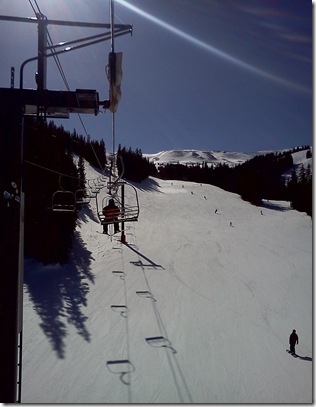 Now I am exhausted and didn’t have the energy to get in a run or work out. But it got me thinking; skiing counts as a workout, but how does it compare to other activities?
All I could find was the amount of calories burned while doing various activities and found this awesome table from Harvard Health (so its probably legit):
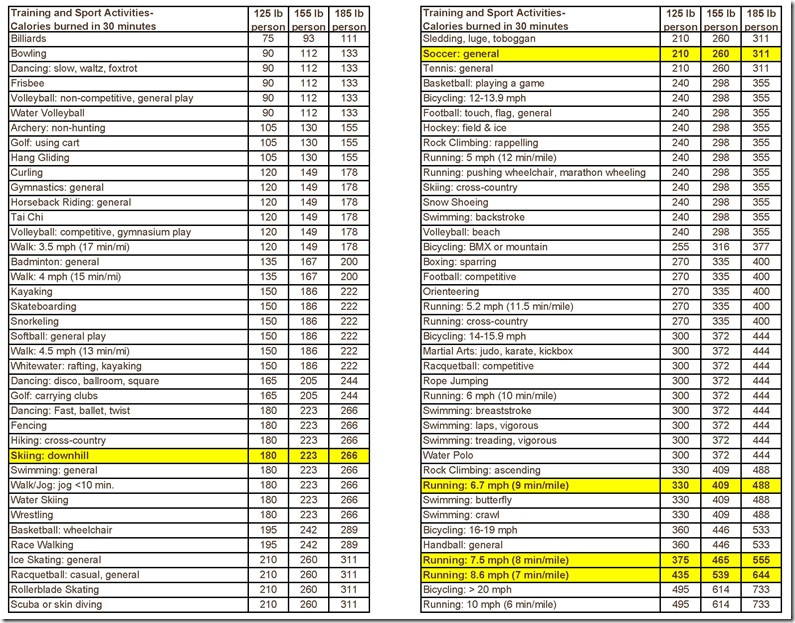 I highlighted the things I do the most and it was really interesting how they compared with each other. And it also reminded me of all the awesome things you can do to be active…. besides running! Granted you don’t burn as many calories as quickly, but that is not always the point. Just get out there and do stuff and you will be doing something. Plus it is good to switch things up to avoid the running burn out…..
 Now I am exhausted and didn’t have the energy to get in a run or work out. But it got me thinking; skiing counts as a workout, but how does it compare to other activities?
All I could find was the amount of calories burned while doing various activities and found this awesome table from Harvard Health (so its probably legit):
 I highlighted the things I do the most and it was really interesting how they compared with each other. And it also reminded me of all the awesome things you can do to be active…. besides running! Granted you don’t burn as many calories as quickly, but that is not always the point. Just get out there and do stuff and you will be doing something. Plus it is good to switch things up to avoid the running burn out…..
Wednesday, February 29, 2012
Paid for Races = Must Start Official Training
Jeff and I just signed up for two races:
April 15, 2012
GO! St Louis Half Marathon
AND
June 9, 2012
Utah Valley Marathon
This means we officially need to start training! Jeff and I hope to PR in both races. I know if we stick with how we have been running, it won't be a problem. Should I put our goal times up on the this blog for all to see??
There are also two half marathons in the Denver area that we will most likely run to use as "training" races:
April 7, 2012
The Redline Westminster Half Marathon
AND
May 20, 2012
The Colorado Colfax Half Marathon
I like running races a few weeks prior to the "official" races that I am trying to PR in. I usually run the first half of these races a bit slower than the goal pace and then the last half at goal pace. It is a good way to build confidence and to verify you are where you need to be. Plus it is good to practice what you will wear and how you plan on eating and drinking.
April 15, 2012
GO! St Louis Half Marathon
AND
June 9, 2012
Utah Valley Marathon
This means we officially need to start training! Jeff and I hope to PR in both races. I know if we stick with how we have been running, it won't be a problem. Should I put our goal times up on the this blog for all to see??
There are also two half marathons in the Denver area that we will most likely run to use as "training" races:
April 7, 2012
The Redline Westminster Half Marathon
AND
May 20, 2012
The Colorado Colfax Half Marathon
I like running races a few weeks prior to the "official" races that I am trying to PR in. I usually run the first half of these races a bit slower than the goal pace and then the last half at goal pace. It is a good way to build confidence and to verify you are where you need to be. Plus it is good to practice what you will wear and how you plan on eating and drinking.
Monday, February 27, 2012
How I Got Faster
I started out to just run; to get in the miles and to complete the distance at hand. I started out struggling to maintain a 9 min per mile pace and didn't know what tempo or fartlek or hill repeats meant. Then running began to get easier and my pace started dropping. My most recent race in December I ran a 7 min per mile pace for 13.1 miles. To get there, I pushed myself at the track, sprinted up hills, and ran faster for progressively greater distances.
It is fun to see yourself improve and to witness how hard work pays off. There is no greater feeling than to commit yourself to training and then run a race faster than you expected to run.... and to feel good while doing it.
 I like to keep my training relatively simple and I make up my own plan by combining several different training plans found on the internet.
Quality over quantity is my motto.
I get in 3 main running workouts every week:
- 1 tempo workout,
- 1 speed or hill workout, and
- 1 long run.
The other 2-3 days, I cross train or get in easy mileage at various distances based on how I feel or what I have time for. I ALWAYS take 1 day a week off from any activity to rest. I also listen to my body and if I am overly tired or sore, I take a day off. You can't run if you are injured!
It is fun to see yourself improve and to witness how hard work pays off. There is no greater feeling than to commit yourself to training and then run a race faster than you expected to run.... and to feel good while doing it.

Quality over quantity is my motto.
I get in 3 main running workouts every week:
- 1 tempo workout,
- 1 speed or hill workout, and
- 1 long run.
The other 2-3 days, I cross train or get in easy mileage at various distances based on how I feel or what I have time for. I ALWAYS take 1 day a week off from any activity to rest. I also listen to my body and if I am overly tired or sore, I take a day off. You can't run if you are injured!
Saturday, February 25, 2012
How to Prepare for the Long Run
Today I am about to go on my weekly long run. I used to dread the long run, but now it is the highlight of my week (yeah, LAME). I love getting outside, putting on some music, and running for hours on end. It allows me to be alone with my thoughts while pushing myself physically.
I also am a fan of a routine, and I have quite the routine the night before my long run. I like keeping things consistent so that my body (and mind) has a routine before long runs and then I keep that same routine the night before a race.


Off to get in my run! Lets hope it goes well!!!
I also am a fan of a routine, and I have quite the routine the night before my long run. I like keeping things consistent so that my body (and mind) has a routine before long runs and then I keep that same routine the night before a race.
Fuel- I will eat dinner at the time I usually do, between 6-7pm. I increase the amount of calories I typically eat and add in some more carbs. For example, last night I had chicken with with mashed potatoes and a side salad (Jeff had talapia with mango salsa because of lent, I had food envy).

Hydrate- I keep my water bottle next to me and make sure I am properly hydrated. If I am running anything more than 13 miles, I will alternate an electrolyte drink with water. I prefer to drink GU Brew or the GU tablets because they are formulated for endurance athletes (they also are not too sugary and taste great).

Music- I make a new playlist for my iPod and download new songs. I love listening to music when I run and especially for long runs. It’s fun to switch up what I have been listening to and I treat myself to some new songs to enjoy. Sometimes I have Jeff surprise me with a playlist that he has made, and this is what he put together for today's long run:

Route- I decide the mileage and then map out the route I am going to take. Not only is it a good idea to decide where you will go (less thinking); it is also smart for safety purposes. I will save the route and email it to Jeff so if for some reason I don’t return, he will know where to look. I prefer to use http://www.gmap-pedometer.com/ because it is easiest to use (better than mapmyrun) and I have found it to be VERY accurate.

Clothing- I look at the weather and decide what clothes I want to lay out. I do this the night before so I don’t have to think about it in the morning. It is in the 40’s and sunny; I'm wearing a long-sleeved technical shirt, a KU t-shirt (because they play Mizzou today and I am supporting my Jayhawks!), half tights, and a hat.

Sleep- It is important to get at least 8 hours of sleep in so that you wake up refreshed. This morning Jeff and I got up a little later so that we slept 10 hours. Look how cozy Jeff looks in the morning, and how Jay thinks he is a human by using a pillow.

Off to get in my run! Lets hope it goes well!!!